Manufacturing of polymeric microfluidic devices
“Lab-on-chip” micro- and nanofluidic devices promise to bring reliable diagnostics to every corner of the globe. To be usable in the field, they must be made in materials that are affordable, transparent and mechanically tough, which makes thermoplastic polymers particularly appealing. Our work in this area addressed the main steps of manufacturing such devices: embossing the features, demolding, checking dimensional fidelity, and bonding layers together.
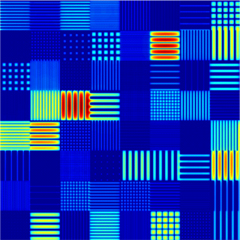
Fast simulation of hot micro-embossing. In hot embossing, a polymer substrate is heated until it softens, a hard, reusable, patterned stamp is pressed into it, and both are cooled and separated. A single pattern may contain thousands of features from below a micrometer to several millimeters across, and the temperature, load and duration must be chosen so that every cavity fills. We developed an extremely fast way of simulating the process that allows these conditions to be chosen efficiently for a given design and material, and is fast enough to guide the design of complex patterns iteratively. Related work examined the detrimental effect of trapped air, and the role of polymer orientation in replication.
Hot demolding. When the stamp and substrate cool at the end of a cycle, differential thermal contraction can induce damaging stresses, so it is appealing to demold at as high a temperature as possible, which also shortens the cycle. Demolding too hot, however, distorts the embossed structures. With Matthew Dirckx in MIT’s Laboratory for Manufacturing and Productivity, we investigated hot demolding of PMMA and proposed suitable parameters.
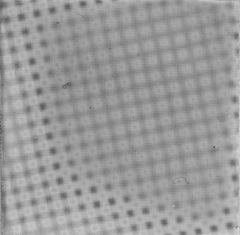
Moiré-based distortion measurement. Demolding at elevated temperatures can also distort the whole embossed layer. These distortions are usually well below 1% but can impede multilayer alignment. With Zhiguang Xu we demonstrated a moiré-based technique for measuring the distortion of an embossed plate several centimeters square using only a flatbed document scanner and a printed reference pattern, with no need to position either precisely.
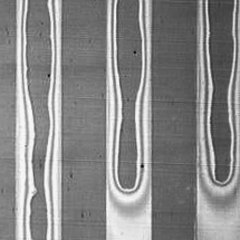
Bonding and bond-toughness measurement. Fluidic devices must be encapsulated, usually by bonding polymer layers together. Thermal bonding is attractive because it introduces no extraneous materials at the interface, but bond toughness must be raised without heat-driven distortion of the features. Plasma treatment before bonding is a much-discussed but little-understood way of doing so. To study such treatments, we invented an integrated micro-crack-opening method for measuring the work of fracture of bonded polymer interfaces. The method is compact, quick and non-destructive; by arraying micro-cracks over a bonded area it can map spatial variations of toughness, and it can follow the erosion of bond toughness over many months.
Key publications
[J6] H.K. Taylor, Y.C. Lam, and D.S. Boning, “A computationally simple method for simulating the micro-embossing of thermoplastic layers”, Journal of Micromechanics and Microengineering, vol. 19, no. 7, 075007, 2009. doi:10.1088/0960-1317/19/7/075007
[J3] H.K. Taylor, D.S. Boning, C. Iliescu and B. Chen, “Computationally efficient modelling of pattern dependencies in the micro-embossing of thermoplastic polymers”, Microelectronic Engineering, vol. 85, no. 5-6, pp. 1453-1456, 2008. doi:10.1016/j.mee.2008.01.015 (Presented at Micro- and Nano-engineering, Copenhagen, Sept. 2007: slides .pdf)
[J10] H.K. Taylor, Y.C. Lam, and D.S. Boning, “An investigation of the detrimental impact of trapped air in thermoplastic micro-embossing”, Journal of Micromechanics and Microengineering, vol. 20, no. 6, 065014, 2010. doi:10.1088/0960-1317/20/6/065014
[J13] R.K. Jena, H.K. Taylor, Y.C. Lam, D.S. Boning, and C.Y. Yue, “Effect of polymer orientation on pattern replication in a micro-hot embossing process: experiments and numerical simulation”, Journal of Micromechanics and Microengineering, vol. 21, 065007, 2011. doi:10.1088/0960-1317/21/6/065007
[J7] X. Zhiguang*, H.K. Taylor*, D.S. Boning, S.F. Yoon, and K. Youcef-Toumi, “Large-area and high-resolution distortion measurement based on moire fringe method for hot embossing process”, Optics Express, vol. 17, no. 21, pp. 18394-18407, 2009. doi:10.1364/OE.17.018394 (* contributed equally)
[C3] M. Dirckx, H. Taylor and D. Hardt, “High-temperature de-molding for cycle time reduction in hot embossing”, in Proc. Society of Plastics Engineers Annual Technical Conference, 2007, pp. 2972-2976. paper .pdf
[NC7] H.K. Taylor and D.S. Boning, “An integrated crack-opening method for determining the work of fracture of bonded polymer interfaces”, in Proc. Micro Total Analysis Systems, San Diego, CA, Oct. 2008. abstract .pdf | poster .pdf
[NC8] H.K. Taylor, C. Iliescu, B. Chen, Y.C. Lam, X. Chen and D.S. Boning, “Modeling pattern dependencies in the micron-scale embossing of polymeric layers”, Proc. SPIE, vol. 7269, 726909, 2009. (invited) doi:10.1117/12.810732
[NC6] H.K. Taylor, X. Zhiguang, L. Shiguang, K. Youcef-Toumi, S.F. Yoon and D.S. Boning, “Moire fringe method for the measurement of distortions of hot-embossed polymeric substrates”, Proc. SPIE, vol. 7155, 715528, 2008. doi:10.1117/12.814582