Modeling of deep silicon plasma etch
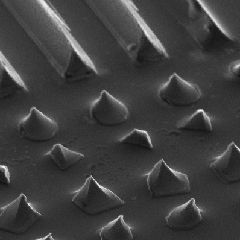
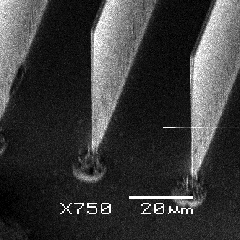
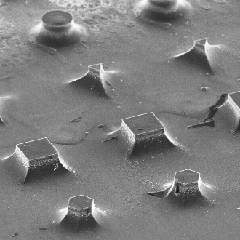
Deep reactive ion etching (DRIE) became a dominant technique for prototyping and manufacturing silicon micro-electro-mechanical systems (MEMS). As DRIE matured and devices were packed more densely onto wafers, it became important to understand and control spatial variations of the etch rate. Besides the well-known feature-size or aspect-ratio-dependent etch (ARDE) non-uniformity, etch rate can vary between regions of the wafer, so that supposedly identical devices vary in performance or fail. Changing the chamber conditions can improve uniformity but usually compromises etching speed and may accentuate ARDE.
An alternative is to lay out the patterns being etched so that they compete for reactants in a controlled way. We demonstrated a way of pre-characterizing any DRIE tool and its recipes: several test wafers are etched and measured, and simple data-fitting algorithms build a model that captures non-uniformity across the wafer diameter as well as variations caused by the local density of patterns. The model fitted etch-rate variation across experimental wafers with errors below 5% r.m.s. per wafer, and could then predict etch rates across a wafer for any mask design in a few seconds, making it suitable for integration into MEMS design tools that guide engineers or automatically insert non-functional etched regions to even out etch rates.
We also observed temporal variations, in which the design of one etched pattern influences the rate and uniformity with which the next wafer etches. Such “memory” effects within the tool diminish over minutes but could matter in production runs of many devices.
Key publications
[J1] H.K. Taylor, H. Sun, T.F. Hill, A. Farahanchi and D.S. Boning, “Characterizing and predicting spatial nonuniformity in the deep reactive ion etching of silicon”, Journal of the Electrochemical Society, vol. 153, pp. C575-C585, 2006. doi:10.1149/1.2209570
[C2] H. Sun, T.F. Hill, H.K. Taylor, M.A. Schmidt and D.S. Boning, “A two-level prediction model for deep reactive ion etch (DRIE)”, in Proc. International Conference on Microelectromechanical Systems, 2005, pp. 491-495. doi:10.1109/MEMSYS.2005.1453974
[C1] T.F. Hill, H. Sun, H.K. Taylor, M.A. Schmidt and D.S. Boning, “Pattern density-based prediction for deep reactive ion etch (DRIE)”, in Proc. Solid-State Sensor, Actuator and Microsystems Workshop, Hilton Head Island, SC, 2004. paper .pdf
[NCb] H.K. Taylor, “Tool- and pattern-dependent spatial variations in silicon deep reactive ion etching”, presented at International MEMS Conference, Singapore, May 2006. (invited) presentation .pdf