The OpenCAL project
After we introduced computed axial lithography in 2019, many research groups wanted to build CAL printers of their own to explore new materials and applications. We first shared our hardware designs and our software for computing projections from a digital model such as an STL file, through the computed-axial-lithography GitHub organization and the open-source Python VAMToolbox.
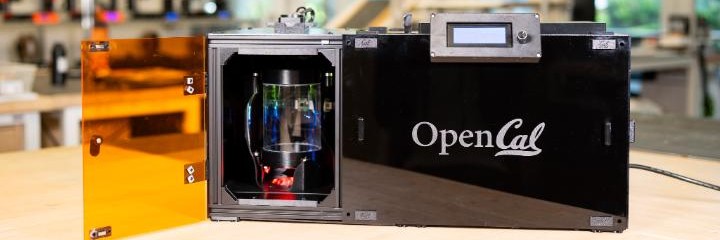
OpenCAL has since grown into a complete, build-it-yourself volumetric printer, developed by a team of more than 40 contributors, mostly Berkeley students, led by Taylor Waddell. The current version uses a consumer projector, a Raspberry Pi 5, a stepper-driven vial mount and an aluminum-extrusion frame with 3D-printed and laser-cut parts. It costs about $1,600 in parts, can be assembled in an afternoon, and forms inch-scale parts in one to two minutes; a model of Rodin’s Thinker prints in about 90 seconds. Print files are prepared with Tomo, a free application built on VAMToolbox, and an OpenCAL resin is produced by Formlabs and sold through Prusa Research, which also hosts the printable parts. OpenCAL machines are running or being built at institutions including MIT, Purdue, NIST and Lawrence Livermore National Laboratory.
The team has demonstrated OpenCAL at Maker Faire Bay Area in 2024, 2025 and 2026, where it received an Editor’s Choice ribbon, and at Open Sauce 2026. An OpenCAL workshop is planned for February 2027, alongside the volumetric additive manufacturing symposium at Berkeley.
Documentation. The OpenCAL documentation is the main reference for building and using the printer, with the bill of materials, CAD, step-by-step assembly guides, software, printing workflow and license terms. We warmly welcome contributions from groups who make improvements and wish to share them. Commercial uses of the CAL process itself must be licensed separately: please contact us.
In the press. Make: magazine, Vol. 97 (June 2026): build guide by Taylor Waddell; 3DPrint.com (October 2026); 3D Printing Industry (October 2026).
Banner: the OpenCAL printer, with its amber safety door open to show the rotating resin vial. Photo: Make: magazine.
Key publications
[C24] T. Waddell, E. Broude, T. Bourgade, N.F. De La Torre, E. Kohyarnejadfard, T. Kaur, S.B. Hao, D. Motley, D. Oslund, E. Percival, R. Summan, C. Vidmar, and H. Taylor, “An open-sourced, community-driven volumetric additive manufacturing printer and post-processor,” in Proc. International Symposium on Academic Makerspaces, Berkeley, CA, Aug. 2025. Preprint: doi:10.48550/arXiv.2509.02865