Condensate shedding for tropical air conditioning
In hot, humid climates such as Singapore’s, a large share of air-conditioning energy goes into removing moisture rather than lowering temperature. When water condenses on an air handler’s aluminum fins it usually forms a continuous film, which insulates the fin and chokes the airflow. If it instead condenses as droplets that roll off (dropwise condensation), air-side heat transfer can improve substantially, and latent and sensible cooling can be handled more efficiently. Through the Berkeley Education Alliance for Research in Singapore (BEARS), we have developed a connected set of surface technologies with one aim: heat-exchanger surfaces that shed condensate as fast as it forms, and that can be made cheaply on aluminum.
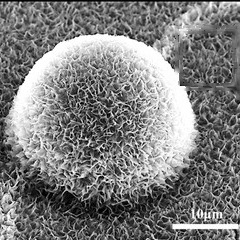
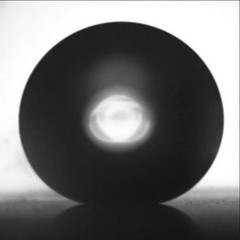
Nanoporous coatings. We developed a bottom-up process that grows nanoporous zinc oxide films with strongly re-entrant features directly on aluminum. The films reach static water contact angles up to 178° with hysteresis below 3°, repel low-surface-tension liquids, and sustain dropwise condensation in flowing humid air. A statistical model of wetting on surfaces with heterogeneous pore geometries explains how such textures resist penetration by different liquids, and we also developed polyvinylidene fluoride microsphere coatings with tunable size and roughness.
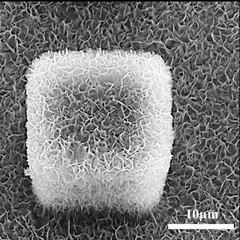
Hierarchical structures. Condensation can flood a nanotexture from within, so we added a second, microscale level of structure. Photolithographically defined micro-domes or micro-pillars carrying a conformal nanoporous zinc oxide coating sustained stable dropwise condensation, with droplets nucleating, coalescing and departing rather than flooding the texture, and a scalable version of the process works directly on aluminum. A third level of hierarchy, in a lotus-inspired triple-hierarchical surface (TriSS) that combines micro-domes, wrinkles and nanohairs, makes the surface exceptionally robust to impinging water.
Translation. The coating technology is protected by US Patent 11,326,060 and was commercialized by the spin-out Nelumbo, founded by Lance Brockway and Liam Berryman. (Listen to a podcast about Nelumbo.)
Banner: nanoporous zinc oxide texture (left), a water droplet resting on the coating (center), and a coated micro-pillar (right).
Key publications
[J20] L.R. Brockway and H.K. Taylor, “A nanoporous, ultrahydrophobic aluminum-coating process with exceptional dropwise condensation and shedding properties”, Materials Research Express, vol. 4, no. 4, 045003, 2017. doi:10.1088/2053-1591/aa613f
[J19] L.R. Brockway and H.K. Taylor, “A statistical model for the wettability of surfaces with heterogeneous pore geometries”, Materials Research Express, vol. 3, no. 10, 105039, 2016. doi:10.1088/2053-1591/3/10/105039
[J22] L. Brockway, L. Berryman, and H. Taylor, “Nonsolvent-induced phase separation synthesis of superhydrophobic coatings composed of polyvinylidene difluoride microspheres with tunable size and roughness”, Progress in Organic Coatings, 2017. doi:10.1016/j.porgcoat.2017.12.013
[J33] S. Chung, K. Kadala, and H. Taylor, “Stable dropwise condensation observed on a hierarchically structured superhydrophobic surface incorporating micro-domes,” Microelectronic Engineering, vol. 225, 111252, 2020. doi:10.1016/j.mee.2020.111252
[C13] K. Kadala, S. Chung, and H.Taylor, “A scalable process for manufacturing hierarchical superhydrophobic structures on aluminum: promotion of stable dropwise condensation for tropical air conditioning,” in Proc. Micro- and Nano-Engineering, Rhodes, Greece, Sep. 2019. (Proceeedings were developed into journal article J33, published 2020)
[J48] S. Chung, C. Riley, and H. Taylor, “A bio-inspired triple-hierarchical superhydrophobic surface (TriSS) with exceptional robustness to water impingement,” Advanced Engineering Materials, vol. 25, 2201315, 2023. doi:10.1002/adem.202201315
[P3] L.R. Brockway and H.K. Taylor, “Liquid-repellent coatings,” US Patent 11,326,060, issued 10 May 2022. Provisional Patent Application 62/207,109, originally titled “A Superhydrophobic Coating,” was filed 19 August 2015. Renamed “Liquid-Repellent Coatings” and filed as a full patent application under PCT/US2016/047680, 19 August 2016.