Printed polymer lattices that reinforce concrete and store heat
This is one of three linked projects on architected polymer–concrete composites, developed with Professor Claudia Ostertag (Civil and Environmental Engineering): octet-truss engineered concrete · polymer lattice-reinforced concrete · polymer–PCM lattice concrete.
The common idea is to borrow from the mechanics of architected cellular materials. Stretching-dominated lattices, such as the octet truss, carry load axially through their struts and so are far stiffer and stronger for their weight than foams with random pores. We use that geometry in three ways: as the concrete itself, as a 3D-printed polymer reinforcement inside concrete, and as a hollow printed container that both reinforces concrete and stores heat.
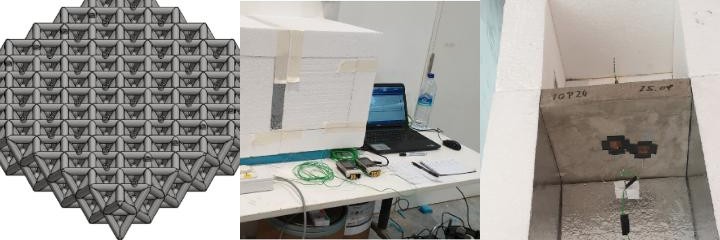
Phase-change materials (PCMs) absorb and release large amounts of heat as they melt and freeze, so building envelopes that contain them can buffer indoor temperatures and cut cooling loads. They are usually added to concrete as micro-encapsulated particles, which can reduce the concrete’s strength. Marcus Maier, Brian Salazar and Cise Unluer instead printed hollow polymer octet-truss lattices, filled them with a PCM that melts at 28 °C, and cast them into cement-based matrices. The lattice therefore acts as both macro-encapsulation and ductile reinforcement.
The macro-encapsulated specimens, containing 20 vol% PCM in both a mortar (2,161 kg/m3) and a lightweight mix (1,351 kg/m3), were compared with mixes containing commercial micro-encapsulated PCM at up to 20 vol%. In hot-box tests they performed best thermally, delaying and slowing the rise of indoor temperature, which makes them promising for passive cooling in tropical climates. Follow-on work coupled computational fluid dynamics and finite-element analysis to design 3D-printed PCM-integrated concrete panels, and reviewed PCMs for climate-adaptive buildings.
Banner: hollow octet-truss lattice for PCM macro-encapsulation (left), the hot-box apparatus (center) and a test panel in the chamber (right). From Maier et al., Journal of Building Engineering 43, 103124 (2021).
Key publications
[J39] M. Maier, B. Salazar, C. Unluer, H.K. Taylor, and C.P. Ostertag, “Thermal and mechanical performance of a novel 3D printed macro-encapsulation method for phase change materials,” Journal of Building Engineering, vol. 43, 103124, 2021. doi:10.1016/j.jobe.2021.103124
[J62] A. Vedrtnam, S. Chaturvedi, D. Gunwant, N. Soares, C.P. Ostertag, K. Kalauni, M.T. Palou, M. Cekon, and H.K. Taylor, “Combined CFD and FEM analysis of 3D printed PCM integrated concrete panels for passive thermal management in buildings,” Applied Thermal Engineering, vol. 279, 127544, 2025. doi:10.1016/j.applthermaleng.2025.127544
[J61] A. Vedrtnam, K. Kalauni, N. Soares, B. Salazar, C.P. Ostertag, and H.K. Taylor, “Phase change materials for climate-adaptive buildings: a review framed by tropical and Mediterranean climates,” Journal of Energy Storage, vol. 125, 116938, 2025. doi:10.1016/j.est.2025.116938