
The additive manufacturing process landscape
Where does volumetric printing sit among additive manufacturing processes, and what physics sets the limits of each? We have approached this question from two directions: the mechanisms by which volumetric methods confine solidification to where it is wanted, and the scaling laws that relate any process’s build rate to the smallest feature it can resolve.
From pixels to voxels. Every volumetric printing method, whether tomographic, light-sheet or multiphoton, has to solve the same underlying problem: light passes through the whole build volume, yet material must solidify only where intended. That requires a nonlinearity somewhere in the process, supplied by oxygen inhibition, photochemical switching, two-step excitation, or a threshold in gelation. With Sandra Van Vlierberghe’s group at Ghent University we wrote a mechanistic perspective that classifies volumetric printing methods by where their nonlinearity comes from, and relates the photochemistry to the achievable resolution, speed and material range. The article was highlighted in Progress in Polymer Science’s “Rising Stars in Polymer Science” series. In a 2024 Nature News & Views piece, Hayden Taylor discussed rapid printing at the curved surface of a liquid and its potential for in-space manufacturing.
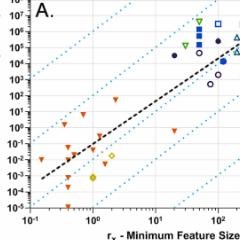
Scaling laws. How fast can a printer build, given the smallest feature it must resolve? With Lawrence Livermore National Laboratory and UC San Diego we compiled volumetric build rate against minimum feature size for a wide range of additive manufacturing processes. The data show a steep, systematic trade-off, roughly cubic, that follows from how each process delivers material and energy: point by point, line by line, layer by layer, or all at once. The analysis identifies which physical constraints set the frontier, places volumetric printing on it, and discusses what the scaling implies for future manufacturing and biomanufacturing systems.
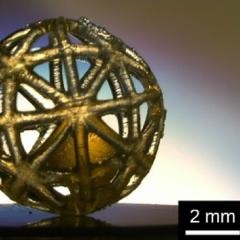
Banner: a volumetrically printed lattice sphere (left), build rate versus minimum feature size across additive processes (center), and a CAL-printed model of Rodin’s Thinker (right). Left and center adapted from Thijssen et al., Progress in Polymer Science 147, 101755 (2023) and Wirth et al., Additive Manufacturing 84, 104081 (2024, CC BY-NC-ND 4.0).
Key publications
[J56] Q. Thijssen, J. Toombs, C.C. Li, H. Taylor, and S. Van Vlierberghe, “From pixels to voxels: a mechanistic perspective on volumetric 3D-printing,” Progress in Polymer Science, vol. 147, 101755, 2023. doi:10.1016/j.progpolymsci.2023.101755 (Highlighted in the journal’s ‘Rising Stars in Polymer Science’ series.)
[J57] D. Wirth, C.C. Li, J. Pokorski, H. Taylor, and M. Shusteff, “Fundamental scaling relationships in additive manufacturing and their implications for future manufacturing and bio-manufacturing systems,” Additive Manufacturing, vol. 84, 104081, 2024. doi:10.1016/j.addma.2024.104081
[J59] H.K. Taylor, “Rapid 3D printing at the curved surface of a liquid,” Nature, vol. 634, pp. 1061–1062, 2024 (News & Views). doi:10.1038/d41586-024-03392-4