SpaceCAL: computed axial lithography in microgravity
Computed axial lithography is particularly promising as an in-space manufacturing process for photopolymers because, unlike layer-by-layer processes such as stereolithography and digital light printing, it does not need a flat interface between the liquid precursor and a surrounding gas. The precursor can be sealed in a transparent container and illuminated from outside. With automated post-processing, CAL could make spare parts, tools, seals and medical items on demand during long missions.
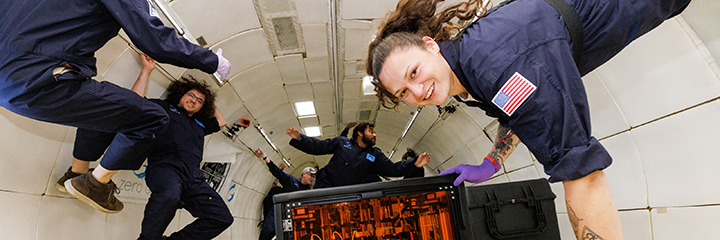
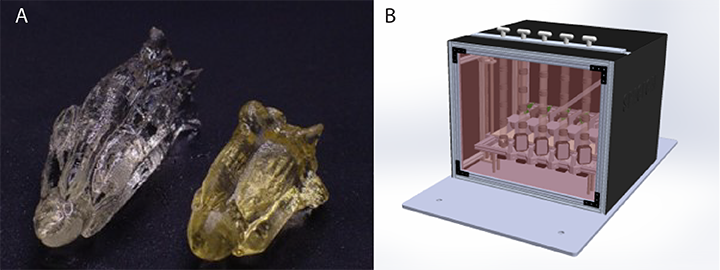
With support from NASA’s Flight Opportunities program, the SpaceCAL project has flown three payloads. Missions 1 and 2, on parabolic flights in May and November 2022, printed more than 450 parts, each in under 20 seconds, at microgravity, lunar and Martian gravity levels. Low-viscosity resins whose parts float and distort when printed on Earth printed stably in microgravity, and flexural tests found no significant difference between parts made in flight and on the ground. Mission 3 flew aboard Virgin Galactic’s SpaceShipTwo (Galactic 07, June 2024) and carried out the first integrated volumetric manufacturing workflow in space: autonomous printing, solvent rinsing and UV post-curing of four parts during about 140 seconds of microgravity, from a 24 kg payload the size of a Space Shuttle middeck locker. The whole sequence used under 9 kJ, a specific energy orders of magnitude below that of extrusion-based in-space printing. A UC Berkeley news story about the first flight is here, and a video by 3D Printing Nerd is here.
Microgravity also lets us separate the effects on print fidelity of the optics, the material formulation and gravity. On Earth, parts printed in low-viscosity resins can sink under their own weight or, as heat from polymerization expands them, float upward while still soft. In flight those motions disappear, so other rate- and resolution-limiting effects can be studied in isolation.
The flights also showed what to improve next. On Mission 3, residual droplets in the resin, aberration toward the edges of the projected field, and uneven rinsing limited part fidelity; each is an engineering problem rather than a limit of CAL. A systems-level analysis using the flight data suggests that a compact CAL unit could substantially reduce the mass of spare parts that a long exploration mission must carry. Next steps include long-duration exposure of CAL-printed parts on the International Space Station through a MISSE mission and an operational apparatus with centrifugal post-processing. We welcome collaborators interested in in-space manufacturing, in-flight metrology, materials for space environments, and medical and life-support applications.
Key publications
[J64] T. Waddell, D. Balk, I. Bourai, S. Chan, B. Chung, S. Chu, A. Elgonemy, J. Gottesman, D. Henry Porcinula, S.A. Mäkiharju, E. Thacher, J. Nickel, A. Moody, D.W. Potter, A.M. Portinause, A. Sreenath, A.R. Young, and H. Taylor, “Demonstration and analysis of volumetric additive manufacturing via sub-orbital spaceflight testing,” Acta Astronautica, vol. 247, pp. 827–842, 2026. doi:10.1016/j.actaastro.2026.05.027
[J54] T. Waddell, J. Toombs, A. Reilly, T. Schwab, C. Castaneda, I. Shan, T. Lewis, P. Mohnot, D. Potter, and H. Taylor, “Use of volumetric additive manufacturing as an in-space manufacturing technology,” Acta Astronautica, vol. 211, pp. 474–482, 2023. doi:10.1016/j.actaastro.2023.06.048