Mechanics of exfoliating and transferring two-dimensional materials
Two-dimensional materials such as graphene, MoS2 and WS2 are held together by weak van der Waals forces, so single layers can be peeled from bulk crystals. Doing this reliably, with monolayers of controlled shape placed where they are needed, is a contact- and fracture-mechanics problem: the interfacial energies, strains and loading path decide which layer separates and where. Our work in this area began with molecular dynamics studies showing that superlubricity between compressed graphite and passivated silicon can thin graphite flakes, and with the printing of controlled folds into graphene using elastomeric stamps of patterned adhesion (with Trinity College Dublin).
With Daryl Chrzan’s, Joel Ager’s and Ali Javey’s groups at Berkeley we used atomistic calculations to explain how the strain induced by a thin deposited metal film influences whether one or several layers are exfoliated. We then developed a patterned-handle process that transfers lithographically defined monolayer MoS2 and WS2 features larger than 104 µm2 directly from multilayer sources. An exfoliate–align–release extension assembles arrays of predefined monolayers into van der Waals heterostructures. To characterize the results quickly, we showed that optical reflectance imaging, with co-optimized wavelength and oxide thickness, reveals interlayer coupling in stacked bilayers, and released the open 2dreflect software on nanoHUB.
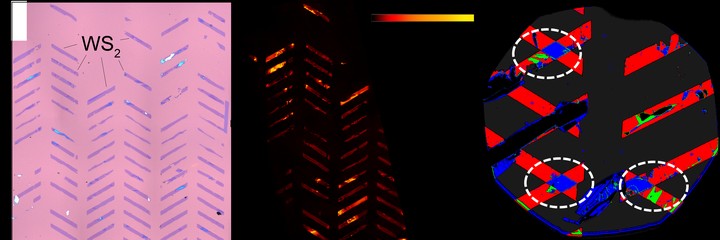
Banner: arrays of monolayer WS2 features transferred onto SiO2, and their photoluminescence map (left and center); automated reflectance-based classification of layer number (right). From Gramling et al. (2019) and the group’s 2dreflect software.
Key publications
[J29] H. Gramling, C. Towle, S.B. Desai, H. Sun, E. Lewis, V. Nguyen, J. Ager, D. Chrzan, E.M. Yeatman, A. Javey, and H. Taylor, “Spatially precise transfer of patterned monolayer WS2 and MoS2 with features larger than 104 µm2 directly from multilayer sources,” ACS Applied Electronic Materials, vol. 1, no. 3, pp. 407–416, 2019. doi:10.1021/acsaelm.8b00128
[J31] V. Nguyen, H. Gramling, C. Towle, W. Li, D.-H. Lien, H. Kim, D. Chrzan, A. Javey, K. Xu, J. Ager, and H. Taylor, “Deterministic assembly of arrays of lithographically defined WS2 and MoS2 monolayer features directly from multilayer sources into van der Waals heterostructures,” ASME Journal of Micro- and Nano-Manufacturing, vol. 7, no. 4, 041006, 2019. doi:10.1115/1.4045259
[J23] H. Sun, E. Sirott, J. Mastandrea, H. Gramling, Y. Zhou, M. Poschmann, H. Taylor, J. Ager, and D. Chrzan, “Theory of thin film mediated exfoliation of van der Waals bonded layered materials,” Physical Review Materials, vol. 2, 094004, 2018. doi:10.1103/PhysRevMaterials.2.094004
[J49] V. Nguyen, W. Li, J. Ager, K. Xu, and H. Taylor, “Optical reflectance imaging reveals interlayer coupling in mechanically stacked MoS2 and WS2 bilayers,” Optics Express, vol. 31, no. 2, pp. 3291–3303, 2023. doi:10.1364/OE.473397
[J17] T. Hallam, A. Shakouri, E. Poliani, A.P. Rooney, I. Ivanov, A. Potie, H.K. Taylor, M. Bonn, D. Turchinovich, S.J. Haigh, J. Maultzsch, and G.S. Duesberg, “Controlled folding of graphene: GraFold printing,” Nano Letters, vol. 15, no. 2, pp. 857–863, 2015. doi:10.1021/nl503460p
[J16] A. Shakouri, J. Yeo, T.Y. Ng, Z. Liu, and H.K. Taylor, “Superlubricity-activated thinning of graphite flakes compressed by passivated crystalline silicon substrates for graphene exfoliation,” Carbon, vol. 80, pp. 68–74, 2014. doi:10.1016/j.carbon.2014.08.026
[P7] H. Taylor, H. Gramling, and E. Yeatman, “Selective transfer of a thin pattern from layered material using a patterned handle,” PCT Patent Application PCT/US18/58508, 2018.
[S6] V. Nguyen, Y. Park, D. Adams, and H. Taylor, “2D material reflectance spectra, version 2.0,” nanoHUB, 2020.