Multi-beam holographic volumetric additive manufacturing
Tomographic printing builds a three-dimensional dose from many intensity-only projections. Holographic projection adds control over the phase of light, so that each beam can itself carry depth information. We developed an intensity-coupled phase-retrieval framework that jointly optimizes the phase masks of several holographic beams, so that their combined, nonlinearly thresholded dose reproduces a target volume.
The framework compares additive, subtractive, multiplicative and holo-tomographic beam configurations and examines the resolution limits that each imposes. Optimizing the beams jointly, rather than one at a time, reduces the reconstruction error in every configuration studied. The work extends the inverse-design view of volumetric printing from amplitude to phase.
Three-dimensional holographic lithography (3DHL)
Our interest in holographic patterning began with three-dimensional holographic lithography, which aimed to form soft hydrogel microstructures, such as scaffolds for in vitro tissue models, quickly and cheaply. Tissue models for studying angiogenesis, tumor-cell migration, neuronal growth or the blood–brain barrier, and for drug screening, need extracellular scaffolds with controlled stiffness, pore size and chemistry, but most hydrogel patterning methods are either two-dimensional or slow and serial.
In 3DHL, iteratively designed holograms are merged with diffractive lenses to form planar phase masks that can be integrated with microfluidic devices. Each element patterns and focuses light at a particular plane within the device, so a 3D scaffold can be built quickly by photo-crosslinking a polymer solution. Because the masks are planar, they could be replicated cheaply over many square centimeters, for example by nanoimprint lithography, making the technique available on demand in any laboratory.
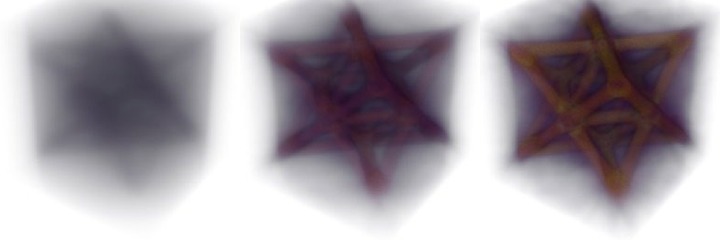
Banner: simulated 3D dose response for an octet-truss target in the holo-tomographic beam configuration, progressing from the initial solution (left) to the jointly optimized multi-beam solution (right); color indicates normalized dose. Adapted from Li et al., Optics Express 32, 47620 (2024).
Key publications
[J60] C.C. Li, J. Toombs, V. Subramanian, and H. Taylor, “Intensity-coupled multi-beam phase retrieval for holographic volumetric additive manufacturing,” Optics Express, vol. 32, no. 26, pp. 47620–47637, 2024. doi:10.1364/OE.544010