Materials for tomographic volumetric additive manufacturing: from hydrogels to glass
Because volumetric printing does not recoat or move layers, it can shape materials that are difficult for layer-based methods: soft hydrogels loaded with living cells, highly viscous resins, and dense nanoparticle suspensions that are later sintered into glass or ceramic. This is why computed axial lithography has been adopted by many bioprinting laboratories.
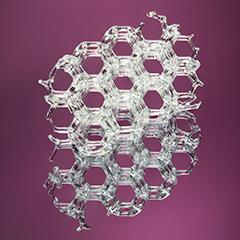
Our own contributions include fused-silica glass printed from nanocomposite resins by microscale CAL, reported in Science in 2022; multi-oxide glasses and ceramics, with the University of Freiburg; sedimentation-free organogel photoresists that hold particles in suspension during printing; and, with Ghent University, a tunable thiol–ene poly(ε-caprolactone) platform for biomedical implants and scaffolds. With the University of Nottingham we have also introduced controlled-radical (RAFT) polymerization into CAL, which tames the heat released during printing and suppresses the buoyant flows that otherwise move parts while they are still soft.
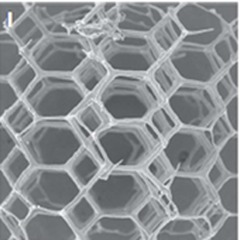
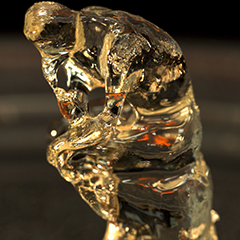
Banner: silica glass microlattices printed by microscale CAL (left and center), and a CAL-printed acrylate model of Rodin’s Thinker (right).
Key publications
[J46] J.T. Toombs, M. Luits, C.C. Cook, S. Jenne, C.C. Li, B.E. Rapp, F. Kotz-Helmer, and H.K. Taylor, “Volumetric additive manufacturing of silica glass with microscale computed axial lithography,” Science, vol. 376, no. 6590, pp. 308–312, 2022. doi:10.1126/science.abm6459. Science magazine cover image, 15 April 2022. Referring link to a free download of the article (no subscription required).
[J63] L. Hambitzer, R. Prediger, Y. Sun, J. Toombs, Z. Hosneolfat, R. Montazeri, S. Kluck, H.K. Taylor, and F. Kotz-Helmer, “Computed axial lithography of multioxide glasses and ceramics from nanoparticles and organic–inorganic precursors,” Additive Manufacturing Letters, vol. 15, 100334, 2025. doi:10.1016/j.addlet.2025.100334
[J65] E. Krumins, Y. Sun, L. Jiang, V. Taresco, D.J. Keddie, R.D. Wildman, H. Taylor, and D.J. Irvine, “Enhanced volumetric additive manufacturing via reversible addition–fragmentation chain transfer (RAFT) polymerization,” Nature Communications, vol. 17, 6907, 2026. doi:10.1038/s41467-026-73456-8
[J50] J. Toombs, I. Shan, and H. Taylor, “Ethyl Cellulose-Based Thermoreversible Organogel Photoresist for Sedimentation-Free Volumetric Additive Manufacturing,” Macromolecular Rapid Communications, vol. 44, 2200872, 2023. https://doi.org/10.1002/marc.202200872
[J51] Q. Thijssen, A. Quaak, J. Toombs, E. De Vlieghere, L. Parmentier, H. Taylor, and S. Van Vlierberghe, “Volumetric printing of thiol-ene photo-cross-linkable poly(ε-caprolactone): a tunable material platform serving biomedical applications,” Advanced Materials, vol. 35, 2210136, 2023. doi:10.1002/adma.202210136
[J55] J. Madrid-Wolff, J. Toombs, R. Rizzo, P. Núñez Bernal, D. Porcinula, R. Walton, B. Wang, F. Kotz-Helmer, Y. Yang, D. Kaplan, Y.S. Zhang, M. Zenobi-Wong, R.R. McLeod, B. Rapp, J. Schwartz, M. Shusteff, H. Taylor, R. Levato, and C. Moser, “A review of materials used in tomographic volumetric additive manufacturing,” MRS Communications, 2023. doi:10.1557/s43579-023-00447-x